

Last updated: July 2026
A guitarist spends three hours chasing a single vocal take that feels right. Meanwhile, an AI tool generates 50 polished song candidates in the same window. Both outputs can sound professional. Both can move a listener. So what actually separates them, and when does it matter for your work?
The debate around human made music versus AI generated music is no longer theoretical. In 2026, 79% of music creators worry about AI-generated music competing with their work, up 5 percentage points from 2023 [2]. At the same time, 68% of independent creators already use AI music tools, mostly because they save money [1]. The tension is real, but the conversation is often stuck on a surface-level question: “Which sounds better?” That's the wrong question. The better question is: “Which decisions matter, and who or what should make them?”
This guide breaks down the real differences between human-created and AI-generated music, not by vibe, but by workflow, control, and outcomes. Whether you're a music producer, a solopreneur who needs background tracks, or someone curious about where AI fits in creative work, here is the plan.
Key Takeaways
- Human made music versus AI generated music is not a binary choice. Most professional tracks in 2026 involve both human and AI contributions at different stages.
- The real difference is where decisions happen. Humans excel at intent, emotional nuance, and long-arc structure. AI excels at generating options fast and handling repetitive production tasks.
- Listeners are biased by labels. Identical recordings are rated as “significantly less moving” when labeled AI-made versus human-composed [1].
- AI can cut production time by up to 80% for background and repetitive projects, but struggles with originality and long-range coherence [1].
- Your clear next step: Stop asking “human or AI?” and start asking “which layer of my production stack needs help?” Then use the 2-minute evaluation rubric at the end of this article to judge any track on its merits.
Quick Answer
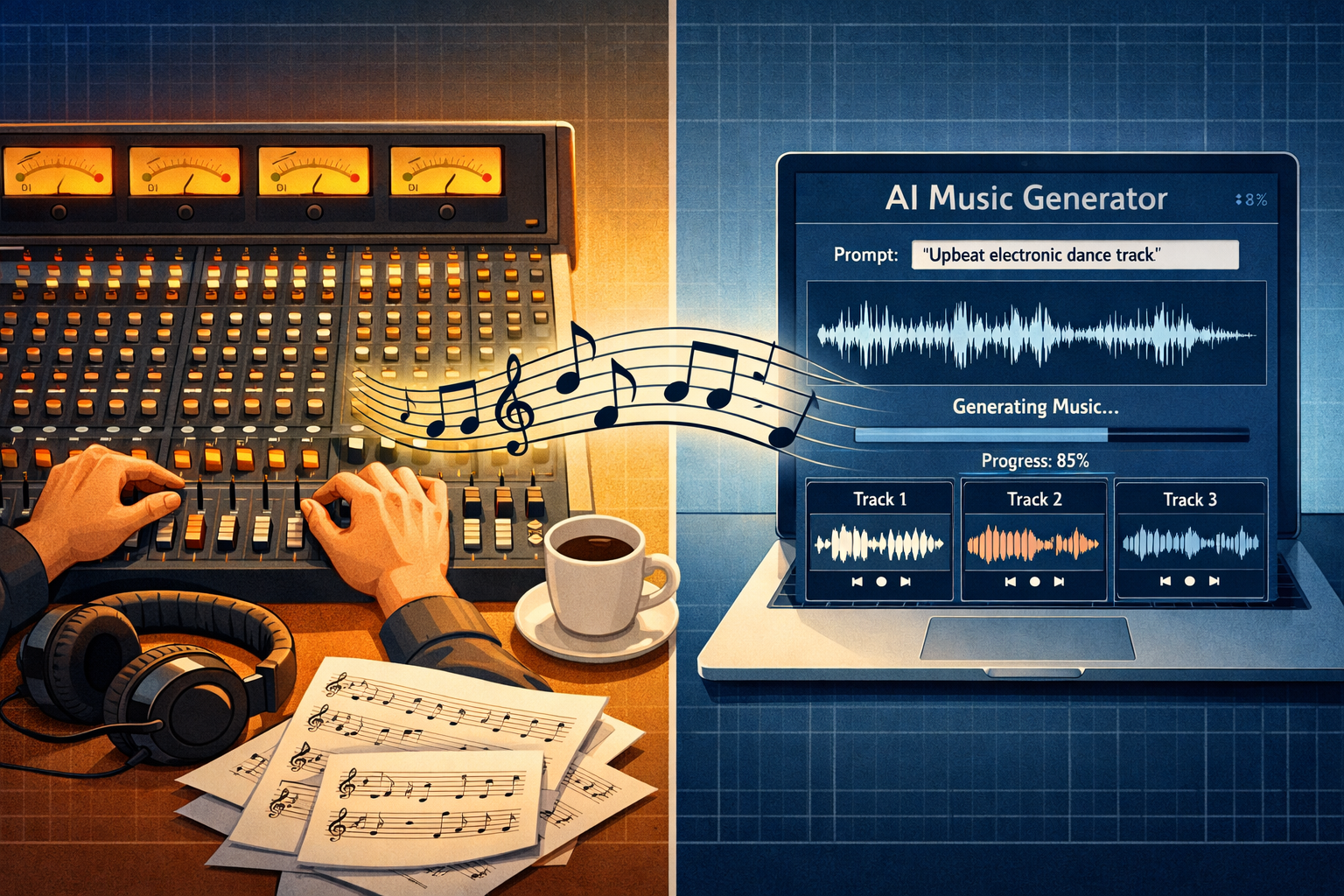
Human made music versus AI generated music differs most in how decisions are made, not in how the final track sounds. Human creation is intention-first: slower, more constrained, but rich in performance nuance and emotional causality. AI creation is constraint-first: fast, variation-heavy, but often generic in structure and weak on the “why” behind choices. In practice, the strongest results in 2026 come from combining both, putting humans in charge of intent and evaluation while using AI where throughput matters.
What Actually Separates Human Made Music from AI Generated Music?
The core difference is the decision-making pipeline, not the sound.
When a human writes and records a song, the process is intention-driven. A songwriter starts with something to say, a feeling to chase, a story to tell. Constraints come from skill, physical ability, available instruments, and time. Mistakes become features. A slightly late snare hit creates groove. A cracked voice on a chorus adds emotion. These aren't bugs; they're the product.
When AI generates music, the process is constraint-driven in a different way. You specify a prompt, a style reference, a mood, a tempo. The model searches its training data for patterns that match, recombines them, and outputs candidates. The “creativity” lives in the selection and editing you do afterward, not in the generation itself.
Here's a simple way to think about it:
| Dimension | Human Pipeline | AI Pipeline |
|---|---|---|
| Starting point | Intent, emotion, story | Prompt, style reference, parameters |
| Speed | Slow (hours to weeks per track) | Fast (minutes to hours per track) |
| Variation per hour | Low (a few takes) | High (dozens of candidates) |
| Long-arc coherence | Strong (learned from years of practice) | Weak (often stitches sections without a clear “why”) |
| Performance nuance | High (micro-timing, breath, dynamics) | Low to moderate (improving but still formulaic) |
| Cost | Higher (studio time, musicians, gear) | Lower (subscription or per-generation fee) |
| Copyright clarity | Generally clear | Still uncertain depending on model and jurisdiction [4] |
A 2025 MIT Media Lab study analyzed over 10,000 AI-generated tracks and found that more than 70% shared nearly identical chord progressions [1]. The tracks were polished. They sounded fine. But they rarely surprised anyone. That's the gap.
Common mistake at this stage: Judging by surface polish alone. Many “human” records in 2026 use heavy pitch correction, quantized drums, sample packs, and template-driven production. Both pipelines can be tool-heavy. The question isn't “does it sound edited?” but “who made the choices that matter?”
Why Do Listeners React Differently to Human and AI Music?
Listeners rate identical music lower when they're told AI made it, and they respond more strongly to human compositions even in blind tests.
A 2024 study published in the Journal of the Acoustical Society of America ran an experiment where identical musical recordings were played for participants. The only variable was the label: “AI-made” versus “human-composed.” The recordings labeled as AI-made were rated as significantly less moving [1]. That's authorship bias, and it's powerful.
But it's not just bias. A separate 2024 PLOS One study monitored 88 participants using heart rate, skin conductance, and self-reported emotion metrics. Human compositions scored consistently higher for expressiveness, authenticity, and memorability [1]. The physiological data backed up what people said they felt.
A 2025 Nielsen analysis found that original human-composed soundtracks achieved 23% higher audience retention and 18% stronger emotional response than generic or AI-generated audio in advertisements [1].
What this means for you: If you're creating music for branding, advertising, or any context where emotional connection drives results, human-composed elements still carry measurable weight. If you're producing background music for a podcast intro or a social media clip, the gap narrows significantly.
For creators thinking about how AI fits into their broader content strategy, our guide on the future of creativity and how generative AI is changing creative work covers the bigger picture across multiple creative fields.
How Does the Human Made Music Versus AI Generated Music Workflow Actually Work?
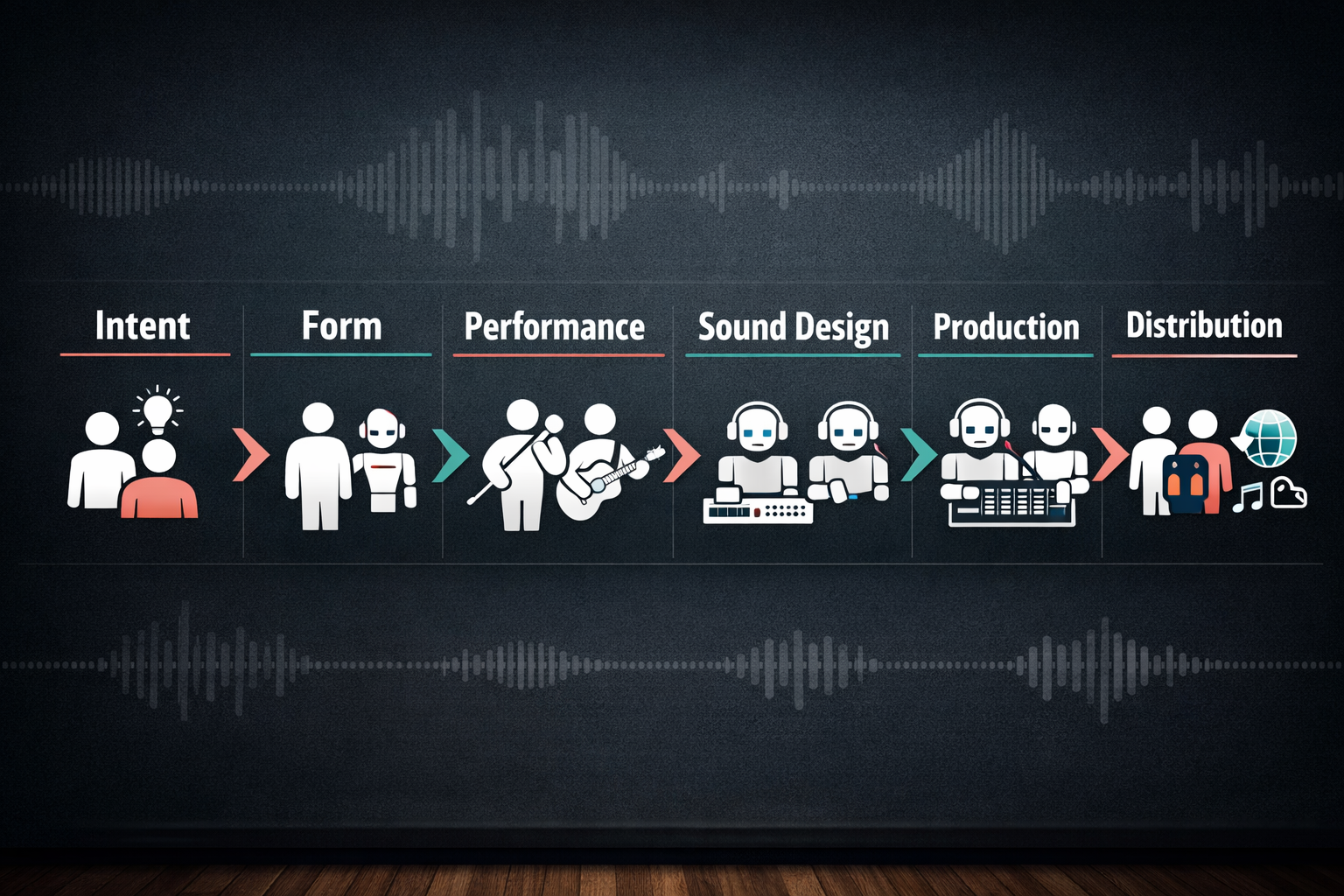
Think of music creation as a six-layer stack. Humans and AI have different strengths at each layer.
Here's the stack, from top to bottom:
- Intent — Why does this song exist? Who is it for? What should it make them feel?
- Form — Structure, tension, release, motif development, lyric architecture.
- Performance — Timing, micro-dynamics, articulation, groove, phrasing.
- Sound design — Timbre choices, spectral space, transient shaping.
- Production — Arrangement density, mix hierarchy, loudness strategy.
- Distribution context — Platform norms, listener environment, attention windows.
Humans tend to be strongest at layers 1, 2, and 3. These require lived experience, emotional intelligence, and the kind of judgment that comes from years of playing, listening, and collaborating. A singer's breath placement before a chorus. A drummer's decision to pull back during a verse. These are performance choices that carry meaning because a person committed to them.
AI tends to be strongest at layers 4 and 5, and increasingly useful at layer 6. AI can generate plausible timbres, suggest arrangement options, and produce “good enough” mixes for many contexts fast. It's also useful for adapting tracks to platform-specific requirements (shorter intros for TikTok, louder masters for Spotify playlists).
The practical takeaway: Stop asking “should I use AI or humans?” and ask “which layer of my stack needs help?” If you're a singer-songwriter with strong melodies but limited production skills, AI can handle sound design and rough mixing while you focus on performance and intent. If you're a producer who needs 20 background track options for a client, AI can generate candidates while you handle selection and final editing.
If you're exploring AI tools for the first time and want a step-by-step walkthrough, check out how to create professional AI music in minutes using the GPT-5 and ElevenLabs method.
What Are the Real Pros and Cons of Each Approach?
Here's an honest breakdown, no hype, just trade-offs that become visible once you've worked with both.
Human Made Music: Strengths
- Fine-grained control through performance. A human can adjust phrasing mid-take based on feel. That level of micro-expression is hard to prompt.
- Long-arc coherence. Humans naturally build tension and release across a 3-minute song because they've internalized thousands of songs over a lifetime.
- Social meaning. Session dynamics, cultural context, and collaboration shape choices in ways that carry through to the listener.
- Clear copyright. You wrote it, you performed it, you own it (assuming proper agreements).
- Higher perceived value. Verified human compositions are expected to command higher licensing rates as platforms adjust algorithms to prioritize authenticity [1].
Human Made Music: Weaknesses
- Time cost. A single polished track can take days or weeks.
- Skill bottlenecks. If you can't play an instrument or sing in tune, you need to hire someone who can.
- Coordination costs. Collaborating with other musicians means scheduling, negotiation, and compromise.
- Limited variation per hour. You get a few takes, not 50 candidates.
AI Generated Music: Strengths
- Speed. AI-assisted workflows can reduce production time by up to 80%, especially for repetitive or background-oriented projects [1].
- Cost-effectiveness. No studio rental, no session musicians, no travel.
- High-throughput exploration. Generate dozens of style variations in minutes.
- Style transfer. Want a track that sounds like lo-fi jazz meets electronic beats? Describe it and get candidates.
- Accessibility. 68% of independent creators use AI music tools, and cost is the top reason [1].
AI Generated Music: Weaknesses
- Inconsistent long-range coherence. Sections can feel stitched together rather than developed.
- Weak “why” behind choices. AI doesn't know why it chose a chord; it chose the statistically likely one.
- Generic phrasing risk. Over 70% of AI-generated tracks in one large study shared nearly identical chord progressions [1].
- Copyright and provenance uncertainty. Legal frameworks are still catching up, and many platforms are discussing lower royalty tiers for fully AI music [4].
- Harder to direct at micro-expressive levels. Getting a specific vocal inflection or drum groove feel requires heavy post-production work.
Decision rule: Choose human creation when emotional specificity, brand identity, or licensing clarity matter most. Choose AI when you need volume, speed, or affordable starting points. Choose both when you want the best of each layer.

Is AI Music Actually “Competing” with Human Music in 2026?
Yes, and creators are paying attention. But the competition isn't as simple as “AI replaces humans.”
According to a February 2026 PRS for Music survey, 76% of creators agree AI has potential to negatively affect their livelihoods, a 7 percentage point increase since 2023 [2]. And the concern grows with understanding: over 70% of creators now understand how AI music creation works (up 19 percentage points since 2023), and greater understanding correlates with greater concern [2].
The competition is most direct in these areas:
- Stock music and library music. AI can produce acceptable background tracks at a fraction of the cost. Producers who relied on volume-based stock music income are feeling the squeeze.
- Sync licensing for low-budget projects. Small YouTube channels and indie games increasingly use AI-generated tracks instead of licensing from human composers.
- Playlist filler. Some streaming platforms have seen an influx of AI-generated tracks designed to capture micro-royalties from ambient and background playlists.
But the competition is weakest in these areas:
- Live performance. AI can't tour, connect with an audience in real time, or build a fanbase through shows.
- Artist identity and brand. Listeners follow artists, not algorithms. Story, personality, and community still drive loyalty.
- High-stakes commercial use. The Nielsen data showing 23% higher audience retention for human-composed soundtracks matters when ad budgets are on the line [1].
- Premium licensing. Verified human compositions are expected to command higher rates as platforms adjust [1].
92% of creators argue AI tools should be transparent about how they generate music [2]. This push for transparency is shaping platform policies and could become a key differentiator for human creators who can prove provenance.
For solopreneurs and content creators looking to build income streams around their skills, understanding these market dynamics matters. Our guide on essential skills every AI consultant needs covers how to position yourself in an AI-influenced market.
How Should Beginners Think About Human Made Music Versus AI Generated Music?
Start with one goal, then pick the tool that fits.
If you're new to music production or just exploring how AI fits into creative work, here's a beginner-friendly framework:
Step 1: Define Your Use Case
Ask yourself: “What do I need this music for?”
- Background for content (podcast, YouTube, social media) → AI tools are a quick win. Generate candidates, pick the best one, and move on.
- Original songs for release → Start with human composition for melody and lyrics, then explore AI for production assistance.
- Client work (ads, films, brands) → Use human creation for hero moments, AI for drafts and exploration.
- Learning and experimentation → Use both. AI tools are great for hearing ideas quickly. Human practice builds real skill.
Step 2: Learn the Stack
You don't need to master every layer right away. Start with one tool at a time:
- Intent and form: Write lyrics, hum melodies, sketch song structures. No tool needed, just a voice memo app.
- Sound design and production: Try an AI music generator (Suno, Udio, or similar) to hear your ideas produced quickly.
- Performance: Record yourself. Even rough vocals or guitar over an AI backing track teaches you about performance causality.
Step 3: Test and Adjust
Generate a track with AI. Then try to make the same track yourself (even a rough version). Compare. Where does the AI version feel flat? Where does your version feel rough? The answers tell you where to invest your time.
Simple workflow for content creators:
- Write a one-sentence brief (mood, tempo, purpose).
- Generate 5 AI candidates.
- Pick the best one.
- Edit: trim length, adjust levels, add a human-recorded element if possible.
- Use the evaluation rubric below to score it.
- Ship it.
This process can save time fast while still giving you creative control over the final product. If you're building a content business alongside your music, our beginner's blueprint for starting an online business covers the fundamentals.
What Assumptions Should You Drop as You Learn More?
Six beliefs that disappear with experience:
“Human equals unedited performance.” It doesn't. Most commercial music involves extensive editing, pitch correction, and quantization. The human contribution is in the decisions, not the raw audio.
“AI equals one click and done.” It doesn't. Effective AI music production involves prompting, selecting from many candidates, editing, re-prompting, and post-production. Curation is the skill.
“Creativity only happens at the moment of first generation.” It doesn't. Choosing which take to keep, how to arrange sections, and when to cut a part is deeply creative work.
“Authorship is a single person.” It rarely is. Even a solo artist uses producers, engineers, and now AI tools. Authorship is modular.
“Sound quality implies musical quality.” It doesn't. A perfectly mixed track can be boring. A rough demo can be unforgettable.
“You can reliably tell human from AI just by listening.” You often can't. And as AI improves, this gets harder. Focus on decision quality, not origin detection.
Understanding these shifts is part of building practical AI skills. For a broader look at how AI tools are changing creative and business workflows, see our overview of AI-powered business tools transforming digital entrepreneurship.
How Will Platforms and Licensing Handle AI Music Going Forward?
Many platforms in 2026 have implemented or are discussing lower royalty tiers for “fully AI” music compared to “human-authored” music [4]. This is a significant development for anyone who earns income from music.
Here's what's taking shape:
- Streaming platforms are experimenting with tiered royalty systems. Tracks verified as human-authored may receive standard royalty rates, while fully AI-generated tracks may receive reduced rates.
- Sync licensing markets are increasingly requiring provenance documentation. Brands want to know what they're licensing.
- The push for transparency is strong. 92% of creators want AI tools to be transparent about their generation methods [2]. This is driving policy conversations at every major platform.
What this means for your strategy:
- If you're releasing music commercially, document your creative process. Keep records of what's human-created and what's AI-assisted.
- If you're using AI for content creation, check the terms of service for your AI music tool. Some restrict commercial use or require attribution.
- If you're building a music career, verified human authorship is becoming a competitive advantage, not just an ethical stance.
For creators who also use AI in their content marketing, our guide on using ChatGPT for content marketing covers how to integrate AI responsibly across your workflow.
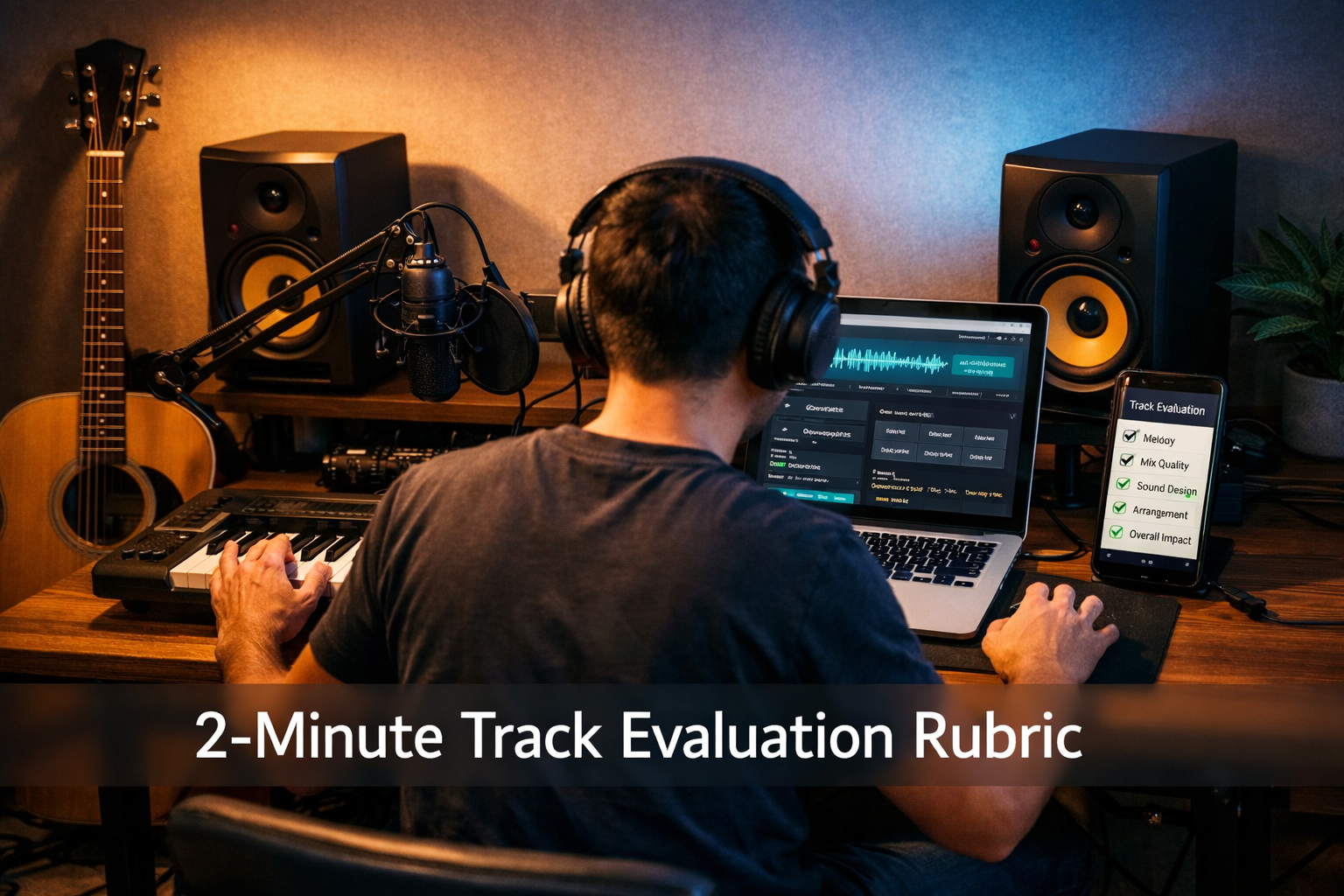
The 2-Minute Track Evaluation Rubric: Score Any Track on Its Merits
Here's a practical tool you can copy and paste to evaluate any track, whether it's human-made, AI-generated, or a hybrid. This rubric focuses on what matters: decision quality, not origin.
How to use it: Play 0:00 to 0:30. Jump to the first chorus or main drop. Play the last 30 seconds. Score each item 0 to 2.
- 0 = Missing or weak
- 1 = Present but inconsistent
- 2 = Strong and consistent
Maximum score: 20
| Category | What to Listen For | Score (0-2) |
|---|---|---|
| A. Intent Clarity | Clear emotional target, energy level, and genre promise within 10 seconds | |
| B. Form & Long-Arc Coherence | Setup, build, release. Motifs introduced early return later with variation. Sections feel connected. | |
| C. Motif Economy | 1-3 memorable motifs carried across sections. No random new hooks that reset the listener. | |
| D. Groove & Micro-Timing | Kick-bass relationship feels intentional. Fills land with purpose. | |
| E. Performance Causality | Can you point to a specific performance choice that creates a reaction? Phrasing, breath, dynamics. | |
| F. Sonic Hierarchy | Lead stays lead. Supporting parts support. No frequency clutter masking the hook. | |
| G. Novelty vs. Familiarity | Recognizable but not generic. Familiar structure with a signature twist. | |
| H. Lyric Architecture | Clear premise. Progression across verses. Chorus states the thesis. (Skip if instrumental.) | |
| I. Editability | Clean section boundaries. Parts can be muted without collapse. | |
| J. Provenance & Risk | Clear ownership. Documentation. License terms. Credit plan. |
Decision Thresholds
- 18-20: Release ready. Minor polish only.
- 14-17: Strong draft. Fix the lowest two categories.
- 10-13: Keep the best 30 seconds. Rebuild the rest.
- 0-9: Treat as a sketch. Extract motifs and start over.
Scoring Sheet (Copy and Reuse)
Track title: _______________
Goal and audience: _______________
Primary reference tracks: _______________

A. Intent clarity:        0  1  2
B. Form & long arc:       0  1  2
C. Motif economy:         0  1  2
D. Groove & micro-timing: 0  1  2
E. Performance causality: 0  1  2
F. Sonic hierarchy:       0  1  2
G. Novelty balance:       0  1  2
H. Lyric architecture:    0  1  2
I. Editability:           0  1  2
J. Provenance risk:       0  1  2

TOTAL: ___/20

Lowest two categories:
1. _______________
2. _______________

Fix plan (3 bullets):
1. _______________
2. _______________
3. _______________
Make it repeatable. Use this rubric every time you finish a track or evaluate a candidate. Over time, you'll internalize the criteria and your quality bar will rise naturally. Results depend on effort, and consistent evaluation is where the effort pays off most.
Frequently Asked Questions
Can listeners tell the difference between human made music and AI generated music? Often, no. In controlled experiments, identical recordings are rated differently based solely on whether they're labeled “human” or “AI” [1]. As AI quality improves, audible differences shrink. Focus on decision quality, not origin detection.
Is AI-generated music legal to use commercially? It depends on the tool, the jurisdiction, and the terms of service. Many platforms in 2026 are implementing tiered systems, and copyright frameworks are still evolving [4]. Always check your AI tool's license terms before commercial use.
Will AI replace human musicians? Not in areas where emotional connection, live performance, artist identity, and premium licensing matter. AI is most likely to replace commodity background music and stock library tracks. Human musicians who invest in intent, performance, and brand will remain differentiated.
How much faster is AI music production? AI-assisted workflows can reduce production time by up to 80% for repetitive or background-oriented projects [1]. For original, emotionally complex music, the time savings are smaller because human judgment is still needed at multiple stages.
Should I disclose if my music uses AI? 92% of creators believe AI tools should be transparent about their methods [2]. Beyond ethics, disclosure is increasingly becoming a platform requirement. When in doubt, disclose. It protects your reputation and your licensing agreements.
What's the best way to combine human and AI in music production? Put humans in charge of intent (why the song exists), selection criteria (what “good” means for this project), and final accountability. Use AI for exploration, drafts, alternate arrangements, and rough production assets. Then evaluate everything with the rubric above.
Does AI music get lower royalties on streaming platforms? Many platforms in 2026 have implemented or are discussing lower royalty tiers for fully AI-generated music compared to human-authored music [4]. Verified human compositions are expected to command higher rates.
What AI music tools do most independent creators use? 68% of independent creators use AI music tools, with cost-effectiveness as the primary reason [1]. Popular tools in 2026 include Suno, Udio, and various DAW-integrated AI plugins. Start with one tool at a time and learn its strengths before adding more.
Is AI music less emotional than human music? Research suggests yes, on average. A 2024 PLOS One study found human compositions scored higher for expressiveness, authenticity, and memorability using both physiological and self-reported measures [1]. But individual AI tracks can still be effective, especially in contexts where emotional specificity isn't the primary goal.
How do I protect my music from AI copying my style? This is an evolving legal area. Document your creative process, register copyrights where possible, and stay informed about opt-out mechanisms that training data providers may offer. The legal frameworks are still developing [4].
Conclusion: Your Clear Next Step
The debate around human made music versus AI generated music gets simpler once you stop treating it as a binary and start treating it as a workflow design question.
Here's what to do this week:
- Pick one project you're working on (a song, a podcast intro, a video soundtrack).
- Identify which layer of the stack needs help: intent, form, performance, sound design, production, or distribution.
- Match the tool to the layer. Use your human judgment for intent and selection. Use AI where you need speed and variation.
- Score the result with the 2-minute evaluation rubric. Be honest about the lowest two categories.
- Fix those two categories and score again.
Build momentum by making this loop repeatable. Every track you evaluate sharpens your ear and your judgment. That skill, knowing what good sounds like and why, is the one thing AI can't replace.
The music industry in 2026 isn't choosing between human and AI. It's learning how to combine them well. The creators who thrive will be the ones who understand both pipelines, use each where it's strongest, and maintain clear accountability for the decisions that matter.
Do this first: download the scoring sheet above, evaluate one track today, and see where it lands. That's your quick win. Everything else builds from there.
For more practical guidance on building AI into your workflow, explore our guide to Google Gemini's personal intelligence features and our resource on creating custom GPTs for your specific needs.
References
[1] Human Generated Music Vs Ai Generated Music – https://www.bensound.com/blog/human-generated-music-vs-ai-generated-music/
[2] More Creators Now Worried About Ai Music Competing With Human Created Music – https://www.prsformusic.com/press/2026/more-creators-now-worried-about-ai-music-competing-with-human-created-music
[3] Watch – https://www.youtube.com/watch?v=RPQT6dLPvMo
[4] The 2026 State Of Ai Music Major Differences And Legal Peace – https://arrangerforhire.com/the-2026-state-of-ai-music-major-differences-and-legal-peace/
SEO Meta: